Discover the love legend behind India's Taj Mahal
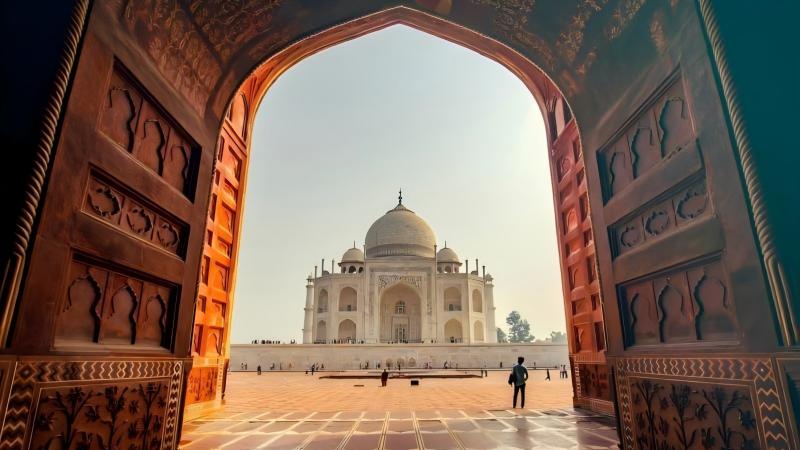
On the banks of the Yamuna River in the Indian city of Agra, a building as white as snow and as beautiful as it is standing still is the Taj Mahal, known as the “Pearl of India” and one of the New Seven Wonders of the World. This magnificent mausoleum is not only a treasure of architectural art, but also an immortal symbol of a poignant love. Behind it lies a stirring love legend between the Mughal Emperor Shah Jahan and his consort, Muttazhi Maha.
1. Meeting and falling in love
The story begins in the early 17th century, when the young and handsome Prince Kurram (later Shah Jahan) met a woman named Ajman Banu by chance in a bazaar. Her beauty, intelligence and grace instantly caught the prince's eye, and Ajman Banu was impressed by Prince Kurram's nobility and valor. The two fell in love at first sight and have been in love ever since. Their love story blossomed in the Mughal court and became the center of attention.
In 1612, after many years of love, Prince Kurram married Ajman Banu. After their marriage, Ajman Banu was given the title 'Muttazi Mahal', meaning 'the best of the court'. She was not only Shah Jahan's close companion in life, but also his right hand in political and military decisions. Whether in the midst of court affairs or during Shah Jahan's years of war, Muttazi Mahal was always by his side, giving him endless support and encouragement. They were inseparable and spent a lot of time together, and had 14 children, which proves their deep affection and close relationship.
2. The Vow to Live and Die Together
However, a twist of fate came when Muttazi Maha died in childbirth in 1631 while accompanying Shah Jahan on his expedition to the Deccan plateau. Before she died, she held Shah Jahan's hand and asked him to build her a unique mausoleum in honor of their love. Shah Jahan was overwhelmed with grief, and as he watched his beloved wife's eyes gradually close, he felt that his world had collapsed in an instant. In order to fulfill his promise to his wife, Shah Jahan decided to dedicate his country's efforts to build a mausoleum like no other, so that the beauty of Muttazi Mahal and their love would be remembered forever.
3. History of the Taj Mahal
The construction of the Taj Mahal, which began in 1632, was a massive and time-consuming project. Shah Jahan called upon the best architects, craftsmen and artists of the time, including those from Persia, Turkey and India, bringing together the best of different cultures and skills.
The main body of the mausoleum is made of white marble, which was sourced from high-quality mines in Rajasthan, India, and transported over long distances to Agra. Craftsmen carefully carved each piece of marble to a mirror-smooth finish and inlaid it with countless precious and semi-precious stones such as diamonds, rubies, sapphires, emeralds, etc., forming exquisite floral patterns, geometric shapes, and Quranic verses, making the whole building shine in the sunlight with a colorful and dreamlike glow.
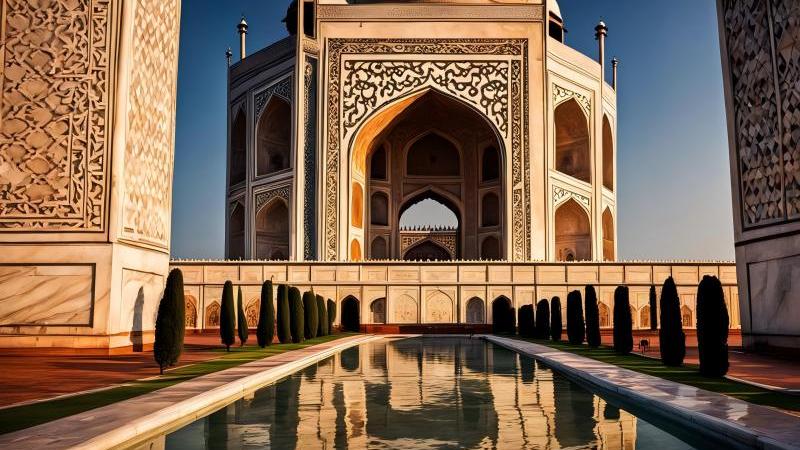
In addition to the main mausoleum, the Taj Mahal includes a magnificent mosque, a symmetrical defense hall, and extensive gardens and courtyards. The garden adopts the typical Persian garden design style, with a wide waterway in the center and neatly planted trees and gorgeous flowers on both sides, which reflect each other with the white mausoleum and create a peaceful and solemn atmosphere.
4. Architectural features and artistic charm
The architectural style of the Taj Mahal combines the essence of Persian, Indian and Islamic architecture, showing a very high artistic standard and unique charm.
From the appearance, the Taj Mahal overall symmetrical layout, the center is as high as 73 meters of the dome mausoleum, mausoleum four corners of each standing a 41-meter-high minarets, these minarets slightly tilted outward, giving a person a kind of shaking but not standing a wonderful feeling, increasing the dynamic beauty of the building and the sense of instability, but also contains a religious symbolism. The front of the mausoleum has a huge arch, with Quranic verses engraved on the lintel, and the surrounding area is decorated with exquisite carvings and inlaid patterns, showing the solemnity and mystery of Islamic architecture.
5. Shah Jahan's later years and the symbolism of the Taj Mahal
Behind this magnificent building, which symbolizes love, lies a sad follow-up story. When the Taj Mahal was about to be completed, Shah Jahan's sons staged a brutal palace coup for the throne. In the end, Shah Jahan was imprisoned in the Agra Fort, where he could only look through the windows of the fortress at the Taj Mahal in the distance and miss his lost love. During his years of captivity, Shah Jahan's physical and mental condition deteriorated, but he never stopped thinking about Bhanu. It is said that he gazed at the Taj Mahal from his window every day until his death in 1666, remembering the good times they had shared.
After his death, Shah Jahan's body was placed inside the Taj Mahal alongside Bhanu's sarcophagus. From then on, the lovers were forever laid to rest in this marble mausoleum, and their love story has been passed down through the ages with the existence of the Taj Mahal as a classic legend in the history of love in the world.
Over the centuries, the Taj Mahal has attracted countless tourists to view and worship it. It is not only a landmark of India, but also a treasure in the world cultural heritage. People from all over the world are impressed by its beauty and romance, in front of this mausoleum, people seem to be able to travel through time and space, feel the deep and passionate love between Shah Jahan and Ajman Banu.
Taj Mahal witnessed a love across the life and death, it with its unique architectural charm and legend, to show the world the great power of love. It is an eternal monument, carrying the memory of history and emotional support, so that everyone who comes here is moved, but also let people have a deeper understanding of love and yearning. In the course of time, the Taj Mahal will continue to stand, and its love legend will be celebrated forever, becoming a dazzling pearl in the treasury of human civilization.